Rock Hill Porta Pros can have portable toilets and handwashing stations on site within hours of a call, not days. When storms knock out water and sewer service, fast placement matters more than anything else. Standard units run $100 to $350 a day depending on volume and duration.
Speed is the whole job during a disaster response. Rock Hill Porta Pros keeps trucks staged so emergency porta potty rental requests move ahead of routine bookings. A single standard unit needs about 44 by 48 inches of ground space and stands roughly 92 inches tall, so it fits on a driveway pad, a church parking lot, or a shelter staging area without much prep. Delivery trucks need close to 60 feet of straight clearance behind them, which matters when a neighborhood has downed trees or debris piles blocking normal access. If Rock Hill or York County activates a shelter at a school gym or community center, we can bring standard porta potty rental units, an ADA accessible porta potty for residents who need one, and a handwashing station rental setup in the same trip. ADA Standards section 213.2 requires that where single-user units are clustered, at least 5 percent, and never fewer than one, be accessible, so shelter sites need that unit counted in from the start, not added later. For households whose own septic system backs up from flooding, emergency septic service and a temporary holding tank rental can bridge the gap until a technician can inspect and pump.
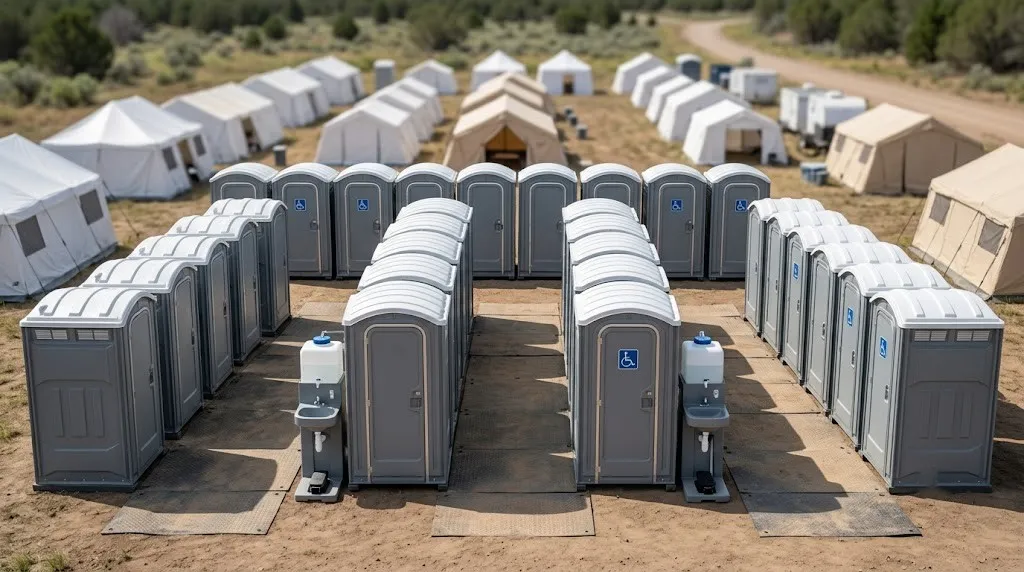
The math is simple once you know the headcount. OSHA 1926.51(c) sets a construction-site baseline of one toilet for 20 workers or fewer, and that same ratio is a useful starting point for volunteer crews and cleanup teams working a disaster site in Rock Hill. Shelters and larger relief operations should also plan around 29 CFR 1910.141(d)(2), which requires soap and towels or a hand-drying device at wash stations. Hand sanitizer alone does not meet that requirement, which is why a hand sanitizer station is a supplement, not a substitute, for real portable sink rental units with running water. Use our how many porta potties do I need guide to size a site fast, and check handwashing requirements for the specifics on what counts. For agricultural properties with hand-labor crews clearing storm damage, OSHA 1928.110 calls for one facility per 20 workers, reachable within a quarter mile, a standard worth knowing if your relief work covers farm ground outside city limits. A deluxe flushable porta potty unit is worth the upgrade for command posts and longer-staffed staging areas where crews are on site for days, not hours.
| unit | duration | typical price |
|---|---|---|
| standard | day | $150 |
| standard | week | $200 |
| ada | day | $230 |
| deluxe | day | $300 |
| service_fee | day | $175 |
Storm cleanup generates two separate waste streams, and disaster response usually needs both handled at once. A roll-off dumpster rental clears tree limbs, wet drywall, and ruined furniture off a property fast, and OSHA 1926.25 requires that debris be cleared from work areas as a basic housekeeping rule for any crew on site. For a full house gut-out after flooding, a 30 yard dumpster rental or 40 yard dumpster rental clears more volume per trip than a smaller box, which matters when disposal sites have limited hours during a regional emergency. Check what cannot go in a dumpster before loading, since certain storm debris like propane tanks or chemical containers needs separate handling. If a relief operation runs long, a storage container rental secures donated supplies, tools, or records overnight, and a mobile office trailer rental gives coordinators a dry place to work. Rock Hill sits within a tight radius of towns that sometimes need the same support: India Hook is 6.8 miles north, Fort Mill is 8.3 miles northeast, and Lesslie is 7.1 miles southeast, so equipment already staged in Rock Hill can reach those areas within the same afternoon. Temporary fence rental also comes up often in storm response, either to secure a damaged structure or to keep foot traffic off unstable ground, and OSHA 1926.202 requires barricades used for employee protection to meet ANSI D6.1.
Standard units run $100 to $350 a day depending on volume, and a delivery fee of $100 to $500 for a single-day order is common during rush placement. Multi-day disaster response usually drops to the weekly rate once service is scheduled past the first 48 hours. See porta potty rental per day for the daily breakdown.
Yes. ADA Standards section 304.3.1 requires a 60 inch turning circle inside an accessible unit, and section 404.2.3 sets a 32 inch minimum clear door opening. Shelters clustering multiple units need at least one accessible unit per ADA 213.2. Request one through ADA accessible porta potty when you place the order.
We assess access before scheduling. Roll-off trucks need about 60 feet of straight clearance behind them, and standard units need a stable, firm placement surface per ADA 302.1 even in emergency deployment. Debris-blocked driveways sometimes require an alternate placement spot nearby.
Call emergency septic service right away. A residential tank is typically pumped every 3 to 5 years under normal conditions, but flooding or heavy inflow can force an early pump-out. A temporary holding tank can cover the household until the system is inspected.
As long as the response requires. Weekly and monthly rates apply once service moves past initial emergency days; see monthly porta potty rental for extended recovery pricing on standard units.
Yes. Rock Hill Porta Pros delivers disaster relief sanitation across Rock Hill and the surrounding metro, with same-day and next-day drop-off available on most orders.
Pricing depends on the unit and how long you need it. See our cost breakdown and request a free quote for an exact figure.
Standard rentals include scheduled service — a pump-out, a clean, a restock and fresh deodorizer. Busy or hot-weather sites can be serviced more often.
Call now or request a free quote — clean units, on-time delivery, transparent pricing.